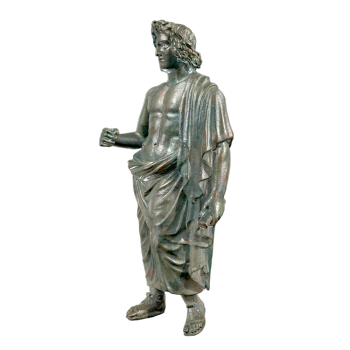
Statue of Nike, the Greek goddess of victory
Niki (Greek: Νίκ η, "victory"; Latin transliteration: Nike) is the goddess of victory in Greek mythology, corresponding to Victoria in Roman mythology. According to Hesiod's Theogony, she was the daughter of the Titan gods Pallas and Styx, as well as the sister of Kratos (power), Biya (strength), and Zeros (passion), all of whom were companions of the main god Zeus. Despite coming from the Titan tribe, she still stood by the side of the Olympian gods in the Titan Wars, bringing them victory.
Discoboluslancellotti discus thrower ancient Greek statue
Discobolus lancellotti is an ancient Greek statue depicting an athlete throwing a discus. This statue is believed to have been replicated based on the work of the ancient Greek sculptor Mirto, 'The discus thrower'. A young athlete was showcased, elegantly poised to throw a discus. The body lines and muscles of the statue are accurately sculpted, showcasing the release of his power and the dynamics of his movements. This statue is renowned for its exquisite artistic skills and accurate expression of human proportions. It is one of the important representatives of ancient Greek sculpture art.
The bronze statue of "Bronze Moses" at Augustana University
The 'Bronze Moses' at Augustana University is a full-size bronze replica of Michelangelo's' Moses' statue created by Felix de Verden. This work was donated by Fenwick, a Cleveland industrialist and former resident of Sioux Falls, in 1974. It was originally completed around 1964 and was exhibited at the Cleveland Museum in Fenwick. This statue is currently located on the campus of Augustana University.
The marble statue of Alexander the Great from the ancient Greek Empire period
The statue was made between the 2nd and 1st centuries BC and came from Alexandria, Egypt. The head of the statue has been cut to accommodate a separately made body. The back of the statue has been processed to receive the remaining parts of hair made from other materials. Alexander the Great was the king of the ancient Greek kingdom of Macedonia, located in present-day northern Greece and neighboring countries. Under his leadership, from 336 BC to 323 BC, Alexander the Great conquered Greek city states, the Persian Empire, and established over 70 cities, creating an empire spanning three continents and covering approximately two million square miles.
Statue of Strangford Apollo in ancient Greece
Strangford Apollo is an ancient Greek statue depicting a naked boy with missing arms and lower legs. This statue was made around 490 BC and is one of the latest examples of youth sculpture type statues, made of Parian marble. This statue has been in the collection of the British Museum since 1864.
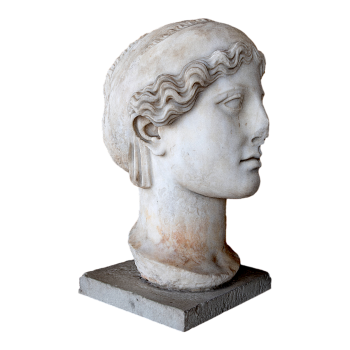
Marble statue of the head of King Apion of Selenica in ancient Greece
Ptolemy Apion was the last king of Cyrenaica in Greece from 150 BC to 145 BC. He is a member of the Ptolemaic dynasty. This statue was made during the Hellenistic period in the 1st century BC and is 36.83 centimeters tall. The statue was discovered in the Temple of Apollo on Mount Panathos in central Greece and is now located in the British Museum.
Statue of Nike, Goddess of Victory
Nike is the ancient Greek goddess of victory, the daughter of the giants Pallas and Styx. Nike symbolizes victory in any field, including art, music, war, and sports. In Greek art, Nike is often depicted as the flying goddess of victory. This sculpture is the most famous work of Greek sculptor Paionios (late 5th century BC). This statue was discovered in Olympia between 425 BC and 420 BC. Including the pillars, the height of the statue is 12 meters. The statue is now in the archaeological museum of Olympia, and the pedestal is still in place in Olympia.
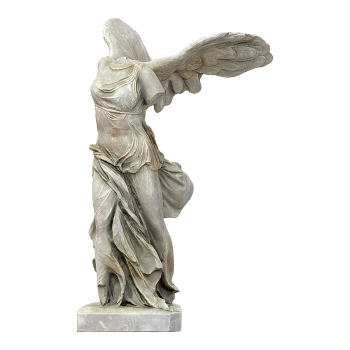
The statue of Milos, the goddess of victory, hidden in the Louvre, France.
One of the most famous statues of the goddess of victory-Nike's Winged Victory of Samothrace. The statue was found in a shrine on a mountain on the Greek island of Samothras, hence its name. It is considered to be a masterpiece of Greek sculpture from the 2nd century BC and is present in the Louvre Museum in Paris, France. The statue depicts a goddess with open wings, standing on the bow of the ship, stepping forward, her clothes flying, and the overall appearance is dynamic and dramatic.
Replica of the discus thrower statue of the ancient Greek sculptor Milan Das
The statue of the discus thrower in Milandas is one of the most famous sculptures in ancient Greece, known as the Discobolus (discus thrower). This statue depicts the movements and postures of a discus thrower before throwing, and is considered one of the most dynamic and naturally flowing works of ancient sculpture.
The original Discobolus statue was created by the ancient Greek sculptor Milandas (Myron) in the 5th century BC. However, the original statue has been lost, and what exists are later replicas or works inspired by it.
Venus statue of Milo 2.02 meters high
The statue of Venus in Milo is a famous piece of ancient Greek sculpture, also known as Venus de Milo. It was found in an ancient city on the Greek island of Milos, hence the name Venus of Milo. This statue is about 2.02 meters high and carved from marble. It was brought to the Louvre in Paris, France in 1863. Since then, it has become one of the important symbols of world art. Milo's Venus statue has attracted countless audiences with its excellent carving skills and elegant image.
Popular Models
Random Model
Vertical projector
358 View
Fox 3D Model Animation
178 View
Cleveland Museum of Art Silver Horn
315 View
White Motor Co in the '40s. City Bus
160 View
IBM 5100 tape drive
290 View
Nissan GT-R R35 GT V2 Supercar
164 View
Old style stage fill light
369 View
Shang Dynasty wine vessels
374 View